No. 13 · Brown & Black
Black Trumpet
Craterellus cornucopioides
“The horn of plenty”
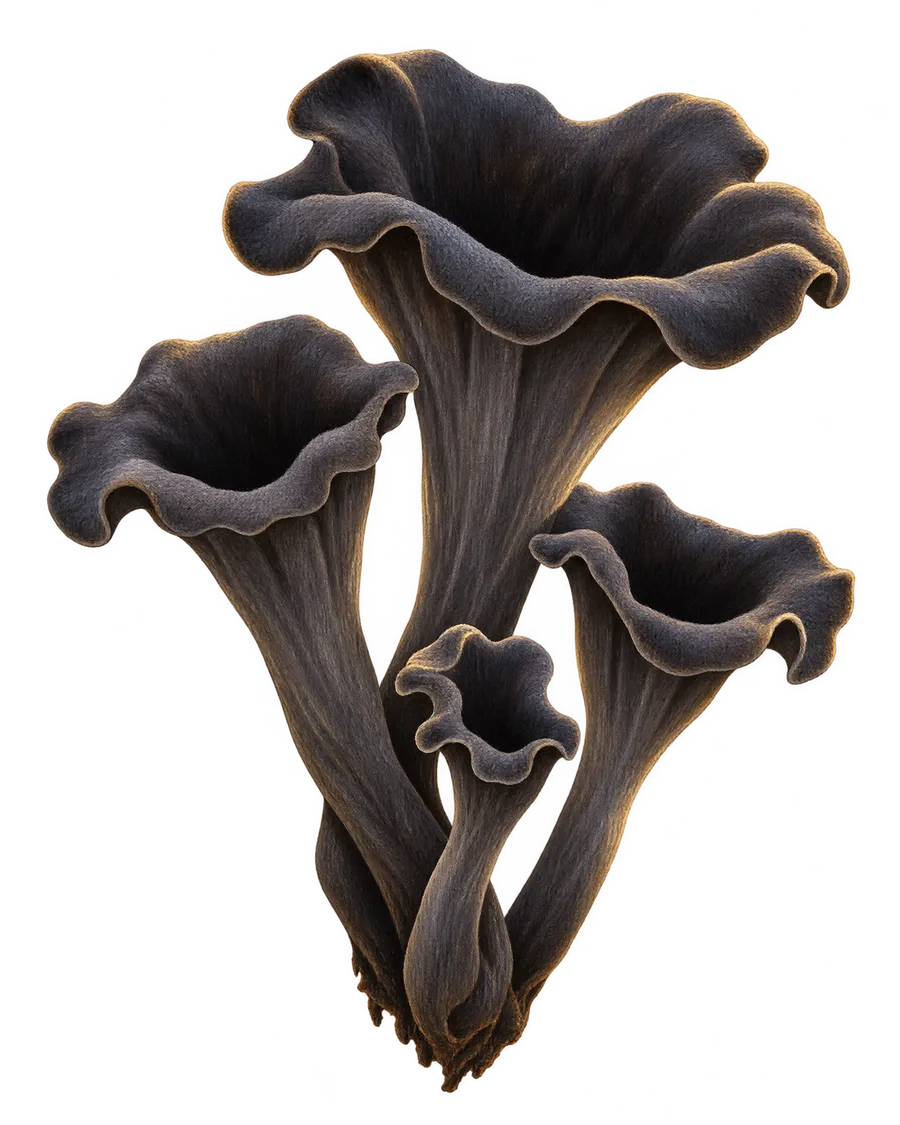
Velvety charcoal trumpets that vanish into the leaf litter. Black trumpets are notoriously hard to spot and wonderfully rich in flavour.
Fun fact!Its scientific name means 'like a cornucopia', the legendary horn of plenty.
- Where in the world
- Europe, North America and Asia
- Home
- Mossy ground under beech and oak
- When to look
- Summer to autumn
- Size
- 4–12 cm tall
The black trumpet is the ninja of the mushroom world. It is shaped like a hollow funnel or a tiny trumpet, dark grey to black, with a velvety inside and a wavy, flared rim. On a forest floor full of dark leaves and shadows, it practically disappears.
Learning to see them
Foragers say you do not find black trumpets, you suddenly notice them. People often walk right past a patch until their eyes adjust. The trick is to stop looking for mushrooms and start looking for small black holes in the leaf litter. Once you see one, you usually find dozens close together.
A hollow mushroom
Black trumpets have no real gills. The outer surface is smooth to slightly wrinkled and greyish, while the inside of the funnel is darker. The trumpet is hollow all the way down to the base, which makes it light and quick to dry.
Where it lives
Black trumpets are mycorrhizal, partnered with beech and oak trees. They like moist, mossy ground and often grow along streams or on gentle slopes after summer rain.
In the kitchen
This is a choice edible, loved by chefs for its deep, smoky, fruity flavour. Black trumpets dry beautifully, and a small handful of dried ones can flavour a whole risotto or sauce. Ground into a powder, they make a dark, aromatic seasoning. As with every wild mushroom, eat them only after an experienced forager has confirmed the identification.