No. 04 · Orange & Gold
Golden Oyster
Pleurotus citrinopileatus
“A bouquet of little suns”
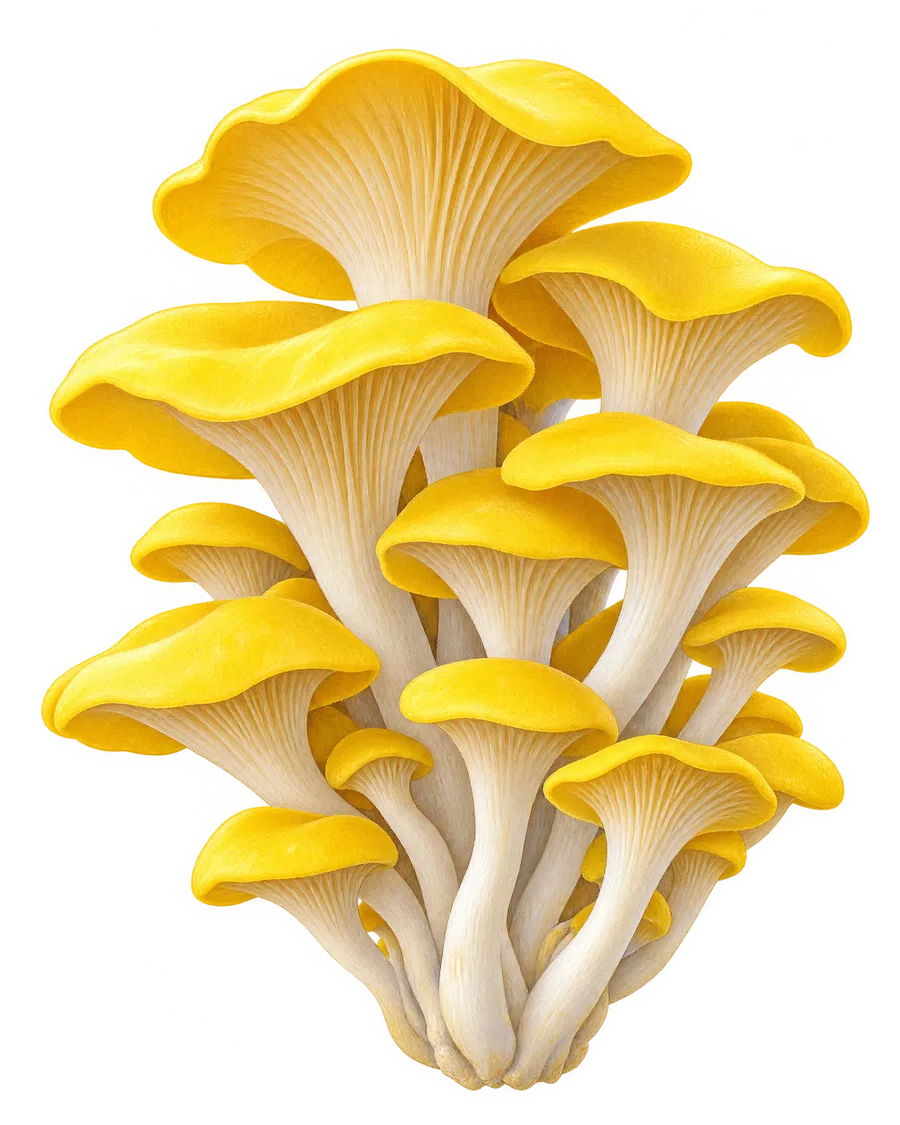
Clusters of lemon-yellow funnel caps on slender white stems, like a bunch of sunshine flowers growing from a log. Beautiful, delicious and surprisingly adventurous.
Fun fact!Escaped from home growing kits, it now grows wild in forests across the eastern United States.
- Where in the world
- Native to eastern Russia, northern China and Japan
- Home
- Dead elm and other hardwoods
- When to look
- Summer to early autumn
- Size
- Caps 2–6 cm
A golden oyster cluster looks less like a mushroom and more like a flower arrangement. Dozens of small, bright yellow caps rise on thin stems from a single base, each cap dipping in the centre like a little funnel. Few fungi are this cheerful to look at.
A traveller
The golden oyster is native to the forests of eastern Asia, where it grows on dead elm and other hardwoods. It became popular with growers around the world because it is fast, colourful and easy to cultivate.
Spores, however, travel. Over the last decade or so, researchers and foragers have found golden oysters growing wild in forests across the eastern United States, far from any farm. Mycologists are now studying how this newcomer affects the native fungi that share the same dead wood. It is a good reminder that even a mushroom can become a globe-trotter.
How it grows
Like all oyster mushrooms, the golden oyster is a wood decomposer. Its mycelium threads through dead wood, breaking down tough fibres. When temperature and humidity are right, it fruits in big flushes, often several times in one season.
In the kitchen
Golden oysters are edible, with a nutty, slightly lemony flavour and a delicate texture. They are thin and cook quickly, so a hot pan and a couple of minutes is all they need. They are best eaten fresh, because the caps become brittle and fade within a day or two of picking.