No. 06 · Brown & Black
Maitake
Grifola frondosa
“The dancing mushroom”
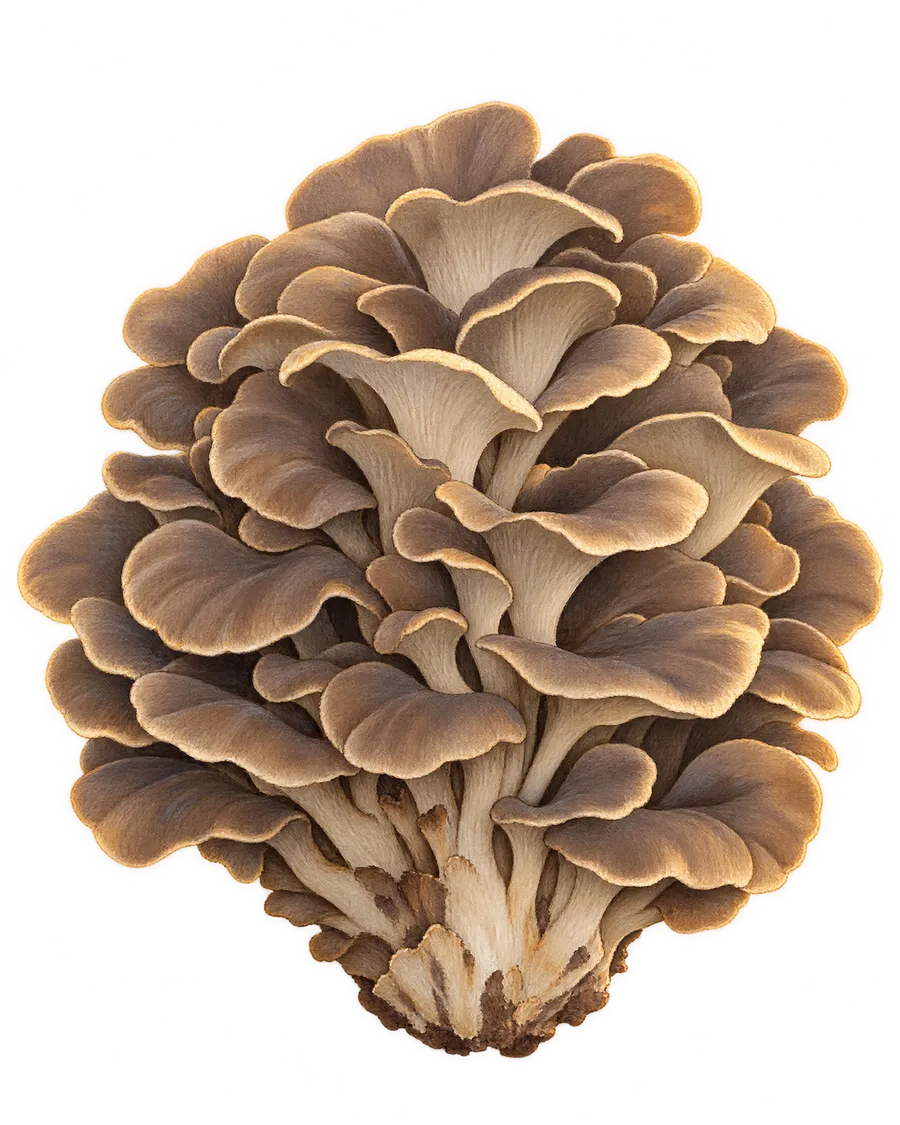
A huge rosette of grey-brown fronds that looks like a ruffled hen sitting at the foot of an oak. In Japan, finding one was once worth a dance of joy.
Fun fact!A single cluster can weigh more than 15 kilograms.
- Where in the world
- Japan, China, North America and Europe
- Home
- The base of old oak trees
- When to look
- Autumn
- Size
- Clusters 10–60 cm across
Maitake is Japanese for “dancing mushroom”. One story says foragers danced with happiness when they found one, because a single cluster was worth its weight in silver. In English it is called hen of the woods, because a big cluster nestled at the foot of a tree looks exactly like a fluffed-up brown hen.
Hundreds of little spoons
What looks like one big mushroom is actually a branching base that carries dozens or even hundreds of small, spoon-shaped caps, all overlapping like feathers. The tops are grey-brown and gently wavy, and the undersides are white and covered in fine pores, which makes maitake a polypore.
Where it lives
Maitake almost always grows at the base of old oak trees, fed by the tree’s roots. Once it has settled in, it tends to come back to the same tree each autumn, which is why foragers have long kept their favourite spots secret.
In the wild it can grow enormous. Clusters of more than 15 kilograms have been recorded.
In the kitchen
Maitake is a choice edible with a rich, deep, almost woody flavour. Pull it apart into small fronds and roast it in a hot oven until the edges turn crisp and the centre stays juicy. Today, almost all maitake in shops is cultivated, so there is no need to raid the forest to enjoy it.