No. 15 · Pink & Red
Octopus Stinkhorn
Clathrus archeri
“The alien in the garden”
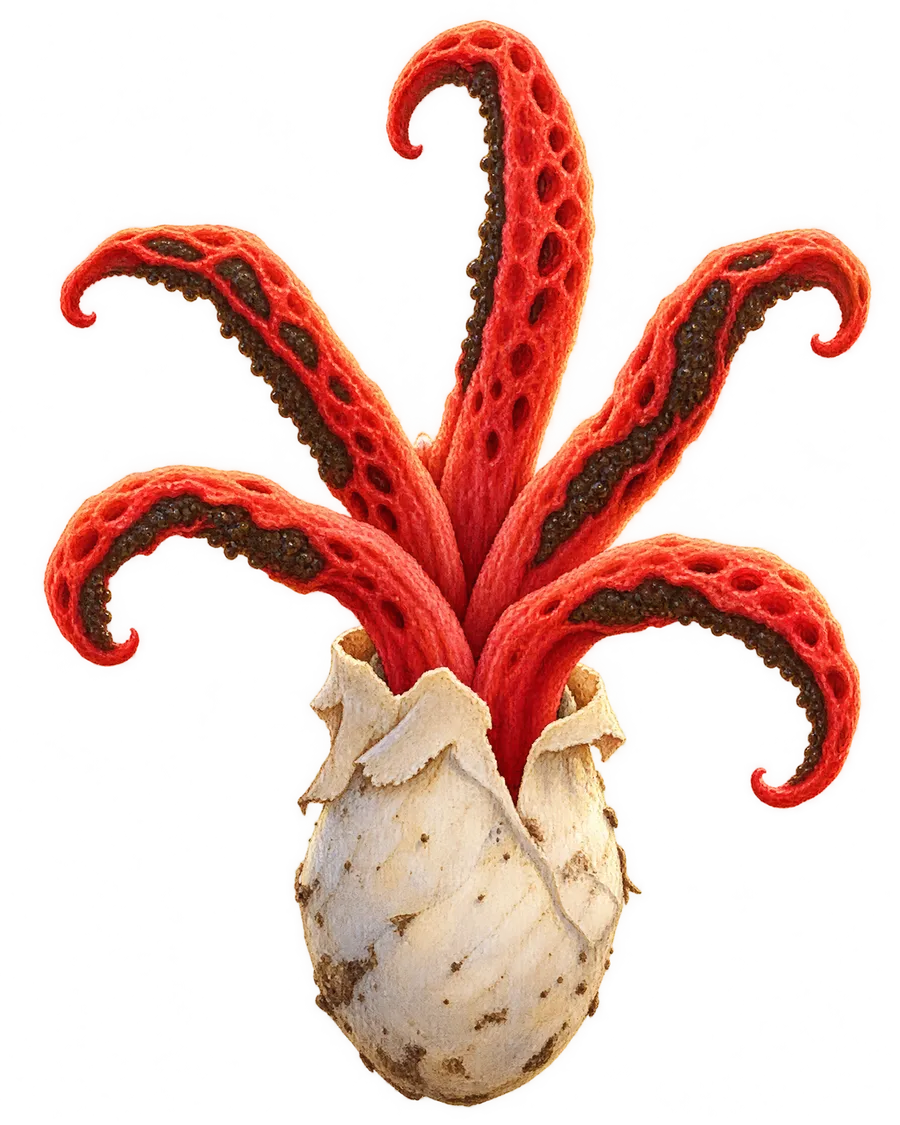
Bright red arms unfurl from a white egg like a starfish or an octopus climbing out of the soil. Strange, smelly and absolutely unforgettable.
Fun fact!It probably reached Europe around 1914, likely carried with wool or supplies from Australia.
- Where in the world
- Native to Australia and New Zealand; now also in Europe and North America
- Home
- Leaf litter, woodland edges, gardens and mulch
- When to look
- Summer to autumn
- Size
- Arms 5–10 cm long
If a mushroom could audition for a science-fiction film, it would be this one. The octopus stinkhorn starts as a pale, rubbery egg in the leaf litter. Then the egg splits, and four to seven bright red arms push their way out, curling backward like the tentacles of an octopus or the legs of a starfish.
A smelly strategy
The inner side of each arm is covered in patches of dark olive slime. That slime is full of spores, and it smells strongly of rotting meat. To us, the smell is unpleasant. To flies, it is irresistible. They land, walk through the slime and fly away covered in spores, spreading the fungus far beyond where it grew. Combined with the red colour, the stinkhorn is a near-perfect fly magnet.
A world traveller
The octopus stinkhorn is native to Australia, New Zealand and Tasmania. It was first recorded in France in 1914, and the most popular theory is that it travelled to Europe with wool or military supplies around the time of the First World War. Since then, it has spread across much of Europe and has also appeared in North America.
Where it lives
It is a decomposer that lives in rich soil, leaf litter and garden mulch, especially in mild, humid areas. Gardeners often discover it by smell before they see it.
Not for eating
The octopus stinkhorn is not eaten. Its fame comes entirely from its looks, and with a face like this, that is more than enough.